Proposition 50 Reshapes California Politics, Putting Five Republican Congressional Seats in Play
alifornia voters approved a new congressional map that could dramatically change the state's political landscape, with competitive races stretching from Northern California to the Inland Empire and San Diego County.

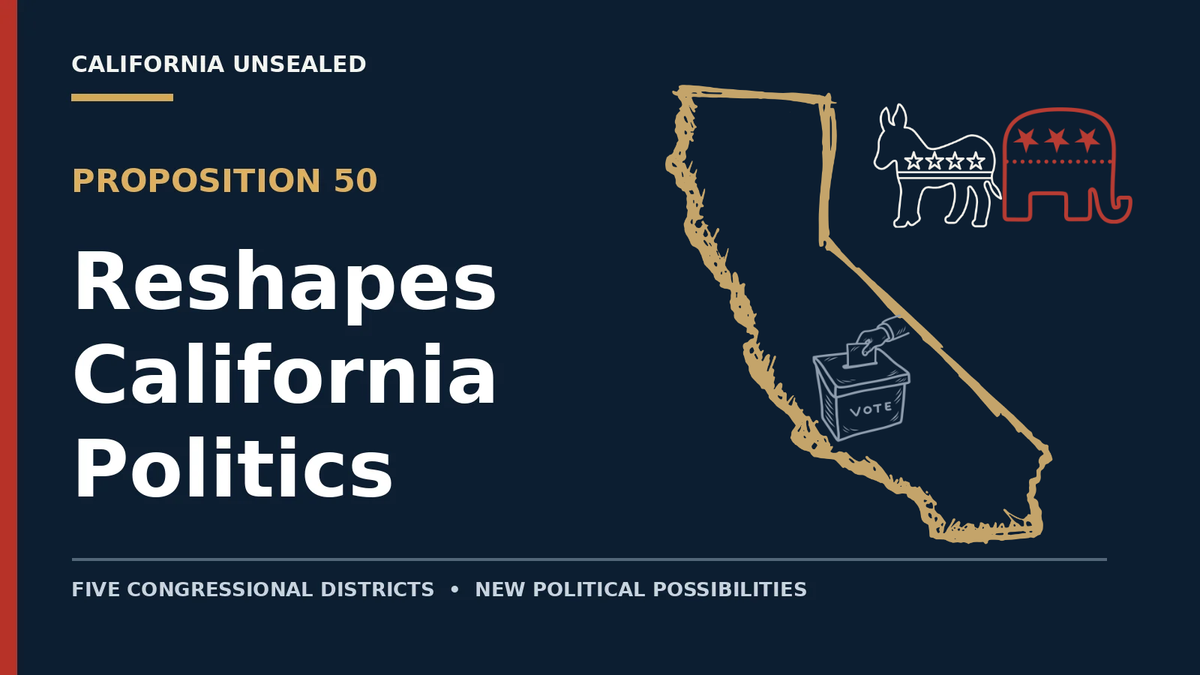
California voters approved a new congressional map that could dramatically change the state's political landscape, with competitive races stretching from Northern California to the Inland Empire and San Diego County.
November 2025 | CALIFORNIA — California's congressional political landscape is undergoing a major transformation following voter approval of Proposition 50, which establishes new congressional district boundaries ahead of the 2026 midterm elections.
The measure, approved by approximately 64% of voters in the November 4 special election, creates new electoral conditions across California's 52 congressional districts, with five Republican-held seats drawing particular attention.
Political analysts at the University of Virginia's Sabato's Crystal Ball and the Cook Political Report identified substantial opportunities for Democrats under the new boundaries. The Cook Political Report's August analysis characterized three Republican-held seats as significantly more Democratic under the proposal, with two additional Republican seats becoming more competitive.
The changes extend across California, from rural Northern California and the Sacramento region to the Central Valley, Inland Empire and San Diego County.
For candidates, political parties and voters, Proposition 50 marks the beginning of a new congressional election cycle in which familiar political boundaries—and assumptions about which districts are competitive—have changed.
Five Congressional Districts at the Center of the Political Shift
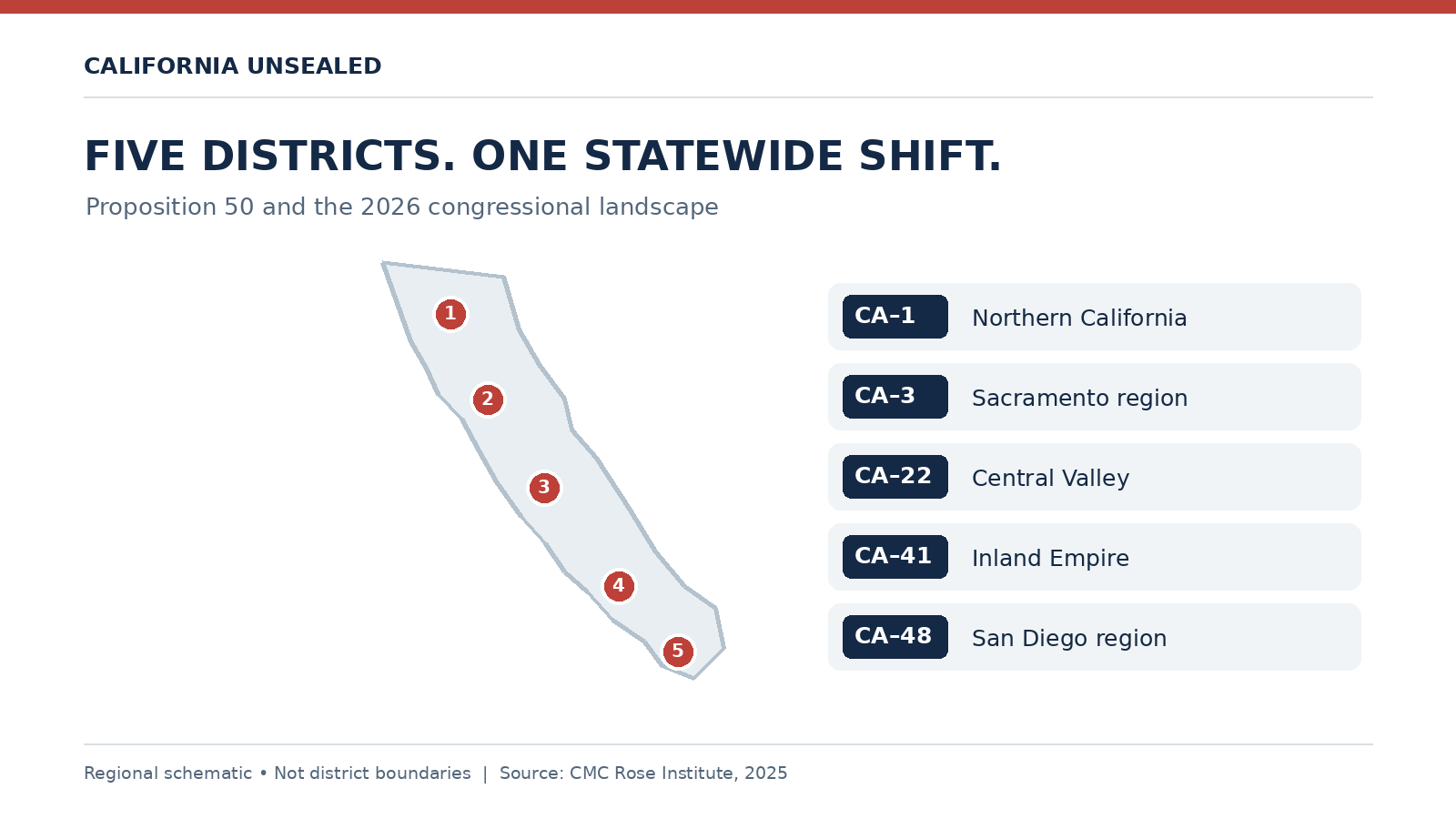
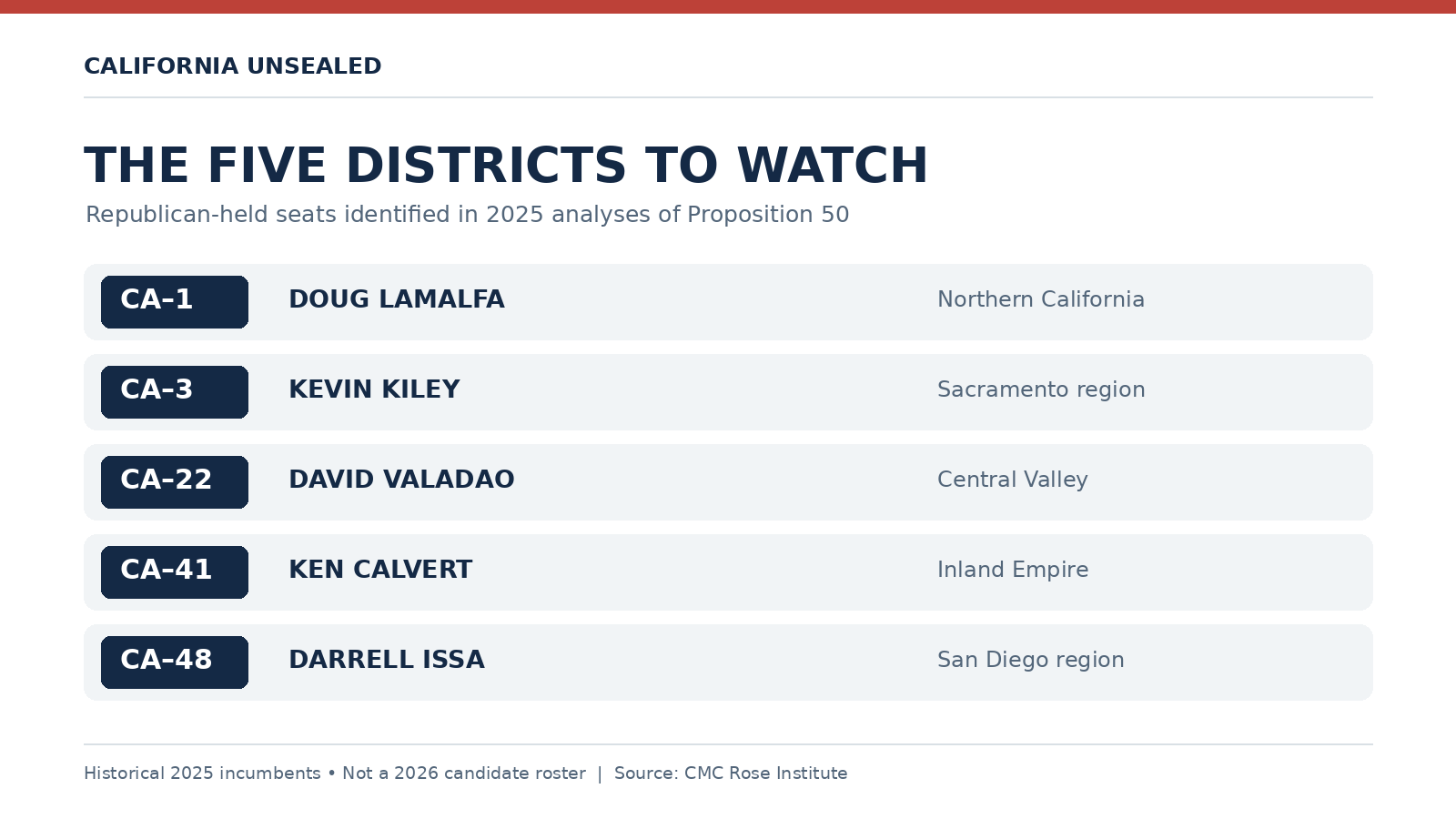
Research from the Rose Institute of State and Local Government at Claremont McKenna College identifies five Republican-held congressional districts as central to the new map's political impact.
The five districts illustrate the geographic reach of California's congressional changes. Rather than concentrating on a single metropolitan area, the new map alters electoral conditions across several regions with different political histories, populations and local priorities.
The Rose Institute's Proposition 50 backgrounder provides an academic examination of the measure, including the congressional districts expected to receive the greatest attention.
Its findings align with broader political analysis identifying California as a central battleground in the national fight for control of the House.
Northern California and the Sacramento Region
Two of the districts identified in the 2025 analysis—CA-1 and CA-3—are located in Northern California.
The new boundaries create a different electoral landscape in territory long associated with Republican congressional representation.
In CA-1, represented at the time by Republican Doug LaMalfa, the redrawn boundaries place new attention on the district's partisan composition and the communities included within it.
In CA-3, represented by Republican Kevin Kiley, the changes similarly reshape the electoral geography of the Sacramento region and surrounding areas.
These districts offer an early indication of how Proposition 50 could influence congressional politics outside California's largest coastal population centers.
They also illustrate an important feature of the new map: its political effects are statewide, reaching regions where Republican candidates have traditionally maintained a substantial presence.
The Central Valley Becomes an Important Battleground
California's 22nd Congressional District, represented by Republican David Valadao, is another focal point.
The Central Valley has long been politically important because of its combination of agricultural communities, growing cities and significant Latino populations.
Valadao has demonstrated an ability to compete in politically challenging territory, making his district an especially interesting test of the new boundaries.
Under the Proposition 50 map, the district's partisan composition changes, creating a different electoral environment for candidates seeking to represent the region.
The outcome will depend on more than the boundaries themselves. Candidate recruitment, turnout, campaign organization and the issues emphasized by voters will all play roles.
For California political observers, CA-22 offers a particularly useful opportunity to examine how new district boundaries interact with established voting patterns.
The Inland Empire Enters a New Congressional Landscape
In Southern California, the 41st Congressional District, represented in 2025 by Republican Ken Calvert, is among the five seats identified in the Rose Institute's analysis.
The Inland Empire has experienced decades of population growth, suburban development and political change.
Those trends have made parts of Riverside and San Bernardino counties increasingly important in statewide and congressional elections.
The redrawn CA-41 adds another dimension to that evolving political environment.
For voters in the region, the new boundaries establish a different congressional electorate ahead of the 2026 election.
For candidates and political organizations, they create a new set of electoral conditions in a region already attracting substantial attention from both major parties.
The district's development will be worth following as campaigns take shape and candidates introduce themselves to voters under the new map.
San Diego County's Changing Political Geography
The fifth district identified by the Rose Institute is CA-48, represented in 2025 by Republican Darrell Issa.
San Diego County's congressional politics have evolved over several election cycles as population changes and shifting partisan preferences have altered the political balance in different communities.
The new CA-48 boundaries introduce another change to that landscape.
Like the other targeted districts, CA-48 illustrates how Proposition 50 extends beyond a statewide political calculation and into individual congressional contests.
The boundaries establish the electoral terrain, but candidates must still compete for support among the voters living within them.
What Political Analysts See in California's New Map
The Cook Political Report's August 15, 2025, analysis described the proposed California map as substantially changing the electoral outlook in five Republican-held districts.
Its assessment distinguished between three seats undergoing particularly large partisan shifts and two additional seats becoming more competitive.
Sabato's Crystal Ball also examined the proposal in its August 18 article, The Gavinmander: How We Would Rate the New California Democratic Map if Voters Approve It.
Together, these analyses help explain why California's redistricting initiative attracted national attention even before voters approved Proposition 50.
The changes do not add congressional seats to California's delegation. The state will continue to elect 52 representatives.
Instead, they alter the boundaries within which those representatives are elected.
That distinction is central to understanding Proposition 50's political significance: the number of seats remains constant, but the electoral composition of several districts changes.
California's Role in the Battle for Congress
Proposition 50 was developed in response to Republican-led congressional redistricting in Texas.
Its approval positioned California as a major participant in the national redistricting contest ahead of the 2026 midterm elections.
California's congressional delegation is already the largest in the nation, giving the state's elections considerable influence over the composition of the House of Representatives.
With control of Congress often determined by a relatively small number of seats, changes affecting five California districts could have consequences far beyond the state.
The national political context helps explain the attention surrounding Proposition 50, but the measure's most immediate effects are within California itself.
The new boundaries change where candidates compete, which voters they must reach and how political parties organize their congressional campaigns.
A New Chapter in California Congressional Politics
With Proposition 50 approved, attention now shifts from the ballot measure to the congressional elections that will take place under the new boundaries.
The five districts identified by political researchers provide an initial roadmap for understanding the changes.
Northern California, the Sacramento region, the Central Valley, the Inland Empire and San Diego County each present different electoral conditions and political histories.
What connects them is the new congressional map—and the opportunities it creates for a different political contest in 2026.
The ultimate outcome will depend on candidates, campaigns and voters.
But one consequence of Proposition 50 is already clear: California's congressional political landscape has changed, and the 2026 elections will provide the first statewide test of those new boundaries.